Contributed dataset · 15 devices · 13 SoCs
How much tuning earns, per chip
One row per device and quantization: the decode multiplier ENTITY earned over the naive 8-thread default on that silicon. It answers "how much does tuning earn on this chip", not "which phone is fastest". Anyone can add a row - run ENTITY Bench unplugged and switch on sharing.
snapshot · 26 submissions
| Device | SoC & model | Naive tok/s | Tuned tok/s | Multiplier | tok/W | Runs |
|---|---|---|---|---|---|---|
| Samsung Galaxy S20 FE 5G 2026-07-24 | Snapdragon 865 Q4_0 | 5.3 | 22.8 | 4.27x | 5.00 | 3 |
| Google Pixel 10 2026-07-22 | Tensor G5 Q4_0 | 7.4 | 27.8 | 3.74x | 5.01 | 3 |
| vivo I2301 2026-07-24 | MT6886 Q4_0 | 4.3 | 16.0 | 3.70x | 3.46 | 1 (1 run) |
| Samsung Galaxy S22 Ultra 2026-07-23 | Snapdragon 8 Gen 1 Q4_0 | 5.1 | 18.1 | 3.56x | 3.81 | 3 |
| Samsung Galaxy S23 2026-07-23 | Snapdragon 8 Gen 2 Q4_0 | 6.7 (high sd) | 23.8 | 3.54x | 3.81 | 3 |
| Samsung SM-A146B 2026-07-25 | s5e8535 Q4_0 | 4.9 | 14.3 | 2.92x | 5.31 | 1 (1 run) |
| OPPO CPH2737 2026-07-23 | Dimensity 8300 Q8_0 | 24.2 | 52.3 | 2.16x | - | 1 (1 run) |
| Nothing CMF Phone 1 2026-07-24 | Dimensity 7300 Q4_0 | 8.9 | 18.1 | 2.02x | 4.30 | 1 (1 run) |
| OPPO CPH2737 2026-07-24 | Dimensity 8300 Q4_0 | 18.3 | 33.3 | 1.82x | - | 1 (1 run) |
| OPPO CPH2553 2026-07-24 | Dimensity 700 Q4_0 | 7.8 | 14.0 | 1.81x | 4.36 | 1 (1 run) |
| Samsung SM-M366B 2026-07-27 | s5e8835 Q4_0 | 9.4 | 16.6 | 1.76x | 3.94 | 1 (1 run) |
| Nothing CMF Phone 1 2026-07-22 | Dimensity 7300 Q8_0 | 15.4 | 25.9 | 1.68x | 7.22 | 1 (1 run) |
| OPPO CPH2729 2026-07-25 | SM6650 Q4_0 | 9.3 | 14.9 | 1.60x | 4.14 | 1 (1 run) |
| Samsung SM-A235F 2026-07-25 | SM6225 Q4_0 | 4.9 | 7.8 | 1.57x | 2.61 | 1 (1 run) |
| TECNO Spark 10 2026-07-24 | Helio G37 Q4_0 | 3.4 | 4.6 | 1.34x | 1.77 | 1 (1 run) |
How to read this board
- Power and tok/W never render from a charging run - a charging phone reports the charger's current, not the workload's. Rows whose arms report physically inconsistent watts are flagged and excluded from power columns; the raw values stay in the detail panel.
- n is always shown. A 1-run row is a single pass and provisional: two back-to-back single passes on the same phone, model and quant have disagreed by up to 19.6%.
- Arms with decode relative SD above 25% are flagged and excluded from every aggregate. One Galaxy S23 naive arm measured 6.72 ± 5.95 tok/s, an 88.5% relative SD - noise, not a measurement.
- One row per device + quantization, newest first, so a phone that submitted six times does not dominate. Older runs expand inside the row; byte-identical re-uploads are collapsed and counted.
- Q8_0 rows are Qwen2.5-0.5B and Q4_0 rows are Llama-3.2-1B - never compare numbers across models; each row's multiplier is within-row and safe.
- The multiplier is not pinning earning energy. On the axis that isolates pinning the median is +0.7% decode and +2.0% tok/W, positive on 9 of 15 rows - small in the middle, wide at the edges (-8.5% to +29.3% decode). The thread count is the lever that generalises.
What the dataset established, and what it falsified
Established
- One binary spans a 7.3x range of silicon, and the ISA tiers are visible in
the crowd data. The same APK and the same
Llama-3.2-1B-Instruct-Q4_0file run from 4.58 tok/s on a Helio G37 to 33.3 on a Dimensity 8300 - 19 contributed runs, no recompile, the backend variant chosen at startup. Split those runs by what the CPU reports:Medians, tok/s. Crossing the dotprod line is worth 9.1x on prompt but only 2.7x on decode - and that asymmetry is the part that means something. A chip that were simply older and slower would drag both axes down together; prompt moving 3.4x harder than decode is the signature of a change in the integer matmul kernel specifically, which is what dotprod is. It is the same compute-bound / bandwidth-bound split the predictor is built on, arriving independently from devices this project does not own. Boundary: only two contributed devices report no extensions at all, so the 9.1x carries every other difference between those chips and the rest with it. The asymmetry survives that; the absolute multiplier should not be quoted alone.Median throughput by reported Arm ISA tier Reported ISA n Prompt Decode no extensions 2 9.9 6.2 dotprod 9 90 16.6 dotprod + i8mm 8 106 21.3 - Thread-count tuning pays on every SoC measured: 1.34x to 4.25x, and no device has regressed (22 rows, 9 SoCs). That range is the thread step alone - naive to threads-only. The multiplier column in the table above is the full naive-to-optimized ratio, so it reads slightly higher (4.27x on the same device); the gap between the two is what pinning contributed. It holds at both ends of the range - on SVE2 flagship silicon and on an all-Cortex-A53 Helio G37 reporting no Arm ISA extensions at all. The widest multiplier is a Snapdragon 865, which has no i8mm: the lever is scheduling, not a kernel.
- Pinning is device-dependent in both speed and energy, and the sign is not predictable from the spec sheet. Median +0.7% decode and +2.0% tok/W, but the Pixel 10 buys +29.3% decode for +33.5% power (tok/W falls) while a Dimensity 7300 gets +24.0% decode for 7.9% less power (tok/W rises 34.4%). A setting, not a default, since v3.5.0.
- The gain tracks core heterogeneity, but clock spread is the wrong
predictor. A near-flat Dimensity 700 gets 1.79x and a wide-clocked
Snapdragon 865 gets 4.25x - yet the Helio G37 has a flagship-like clock spread and
gains only 1.34x, because all eight of its cores are Cortex-A53. What matters is
relative core strength;
cpu_capacitiesis the better candidate and is not yet tested against this table.
Falsified
OPTIMIZATIONS.md predicted a flagship with more than four performance cores would derive 5 or 6 generation threads. The dataset showed the opposite: the rule counted cores within 10% of the fastest clock, and every modern flagship puts its prime core 17-20% above its own big cluster - so the count collapsed to 1 and was clamped to 2. A Dimensity 7300 prefilled at 139 tok/s while an SM8550 with i8mm managed 111. Fixed in v3.5.0 with cpu_capacity.
| SoC | top MHz | pass 10% | after clamp |
|---|---|---|---|
| Dimensity 7300 | 2500 | 4 | 4 |
| Tensor G5 | 3782 | 1 | 2 |
| SM8550 | 3360 | 1 | 2 |
| SM8450 | 2995 | 1 | 2 |
A8 - Pinning is a speed lever with a power cost
Threads-only vs optimized run the same thread count; affinity is the only difference. Flip it per device: decode and watts move together, and tokens per watt often moves the other way.
tokens per watt: -
Pixel 10
Tensor G5 · 3 runs, contributed
- decode
- +29.3%
- watts
- +33.5%
- tok/W
- -3.2%
CMF Phone 1
Dimensity 7300 · 5 runs, 2026-07-18 export
- decode
- +20.7%
- watts
- -3.2%
- tok/W
- +25.4%
OPPO CPH2729
Snapdragon 6 Gen 4 · 5 runs, 2026-07-18 export
- decode
- +0.6%
- watts
- -29.4%
- tok/W
- +44.9%
Galaxy S23
Snapdragon 8 Gen 2 · 3 runs, contributed
- decode
- +1.7%
- watts
- +1.1%
- tok/W
- +0.2%
On the axis that isolates pinning (threads-only to optimized), the contributed dataset's median is +0.7% decode and +2.0% tok/W, positive on 9 of 15 rows - but the range runs -8.5% to +29.3% and both ends are real: one phone pays 33.5% more power to go 29.3% faster, another goes 24.0% faster on 7.9% less power. Nothing knowable before running it says which you have. That is why v3.5.0 made core placement a user setting instead of an assumption, and why the app reports the measurement from the user's own phone.
Privacy, in the app's own words
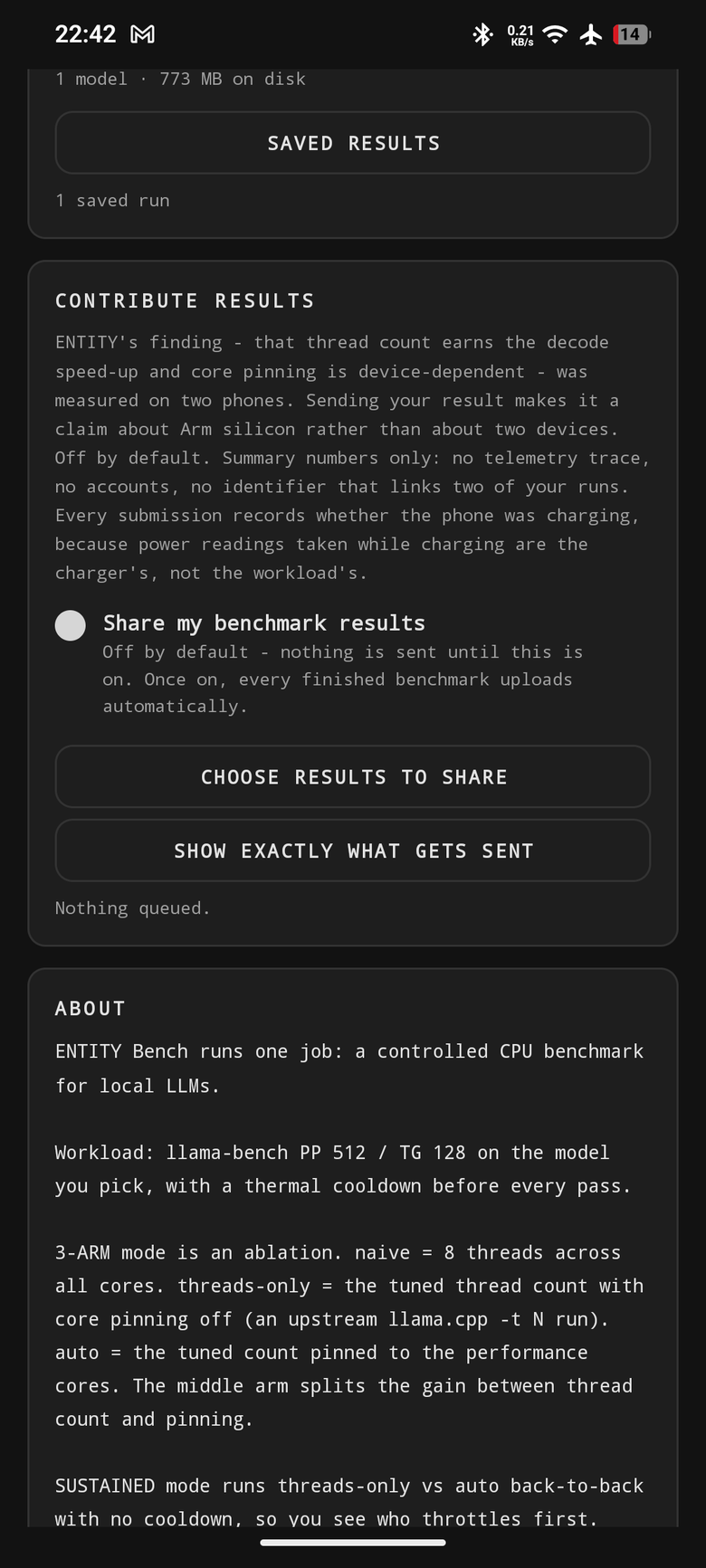
- Contribution is off by default - nothing is sent until the toggle is on.
- Summary numbers only. The per-pass 150 ms telemetry trace never leaves the phone.
- No accounts, no identifier that links two runs from the same phone.
- Every submission records whether the phone was charging, because power readings taken while charging are the charger's, not the workload's.
- A "Show exactly what gets sent" screen renders the real JSON before the first upload.
This page reads that same public, non-identifying dataset over PostgREST with the publishable key. The key can only append rows and read them; the row-level-security policy is documented in benchmarks/CONTRIBUTE-BACKEND.md.
Contribute a row
- Install ENTITY Bench (arm64, Android 13+).
- Import or download a GGUF, unplug the phone, run the 3-arm benchmark.
- Settings → Contribute results → enable sharing.